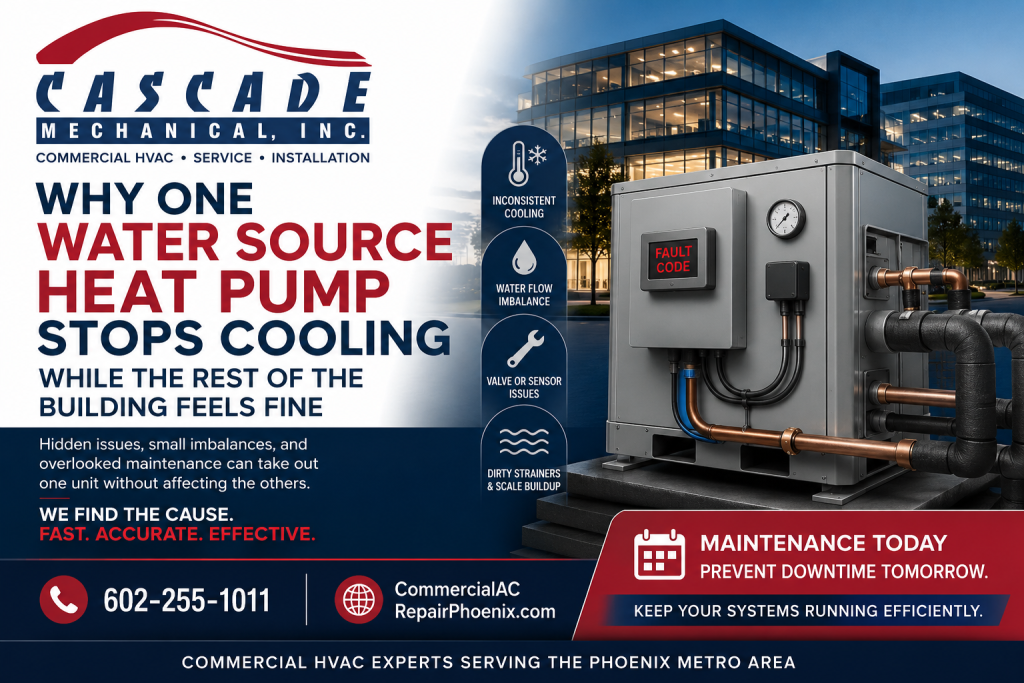
Water source heat pump systems can make commercial zoning flexible. Each unit serves its own area while exchanging heat with a common water loop. That arrangement also creates a distinctive complaint: one office, hotel room or suite becomes uncomfortable while the rest of the building appears normal.
When only one zone is affected, the problem may be inside that heat pump. When several units struggle at once, the shared loop, pumps, cooling tower, boiler or controls may deserve attention.
Start by Comparing One Zone With the Rest of the Building
The first useful question is whether the problem is isolated. If one unit is blowing warm air while neighboring zones are cooling normally, the building loop may still be supplying acceptable water conditions.
If multiple heat pumps lose capacity around the same time, the technician needs to look beyond one cabinet. Loop temperature, circulation, pump operation and central equipment can influence every connected unit.
Airflow Problems Can Look Like a Refrigeration Failure
A water source heat pump still depends on proper airflow across its indoor coil. A loaded filter, dirty coil, blower problem or blocked return can reduce capacity and make the space slow to reach temperature.
Facility staff can check whether a filter is visibly dirty and whether supply and return openings have been blocked. Internal electrical, refrigeration and control diagnosis should be left to qualified technicians.
When airflow is poor, the unit may run longer, produce less useful cooling or eventually shut down on a protective control.
Water Flow Matters Just as Much as Airflow
The water side is what makes this equipment different from a conventional air cooled system. Each heat pump needs suitable water flow and entering water temperature.
A closed control valve, clogged strainer, air in the loop, weak pump performance or a broader circulation problem can reduce the unit’s ability to reject or absorb heat. Technicians can compare entering and leaving water conditions, verify valve operation and check whether the loop is delivering the flow the equipment expects.
A unit that repeatedly locks out should not simply be reset over and over. The lockout may be protecting the compressor or refrigeration circuit from an abnormal operating condition.
Controls Can Create an Isolated Comfort Problem
Thermostats, unit controllers, sensors and communication wiring can produce symptoms that resemble mechanical trouble. A unit may receive the wrong mode command, fail to energize a valve or report a temperature that does not match actual conditions.
Modern commercial water source heat pumps may also communicate with a building automation system. That lets technicians compare commanded operation with what the unit is actually doing.
Before changing parts, the service technician should determine whether the fault is mechanical, electrical, water related or control related.
Use October to Test Heating as Well as Cooling
Phoenix businesses may still need cooling in October, but cooler mornings make this a useful time to confirm that reversible heat pump units can change modes correctly.
A unit that cooled adequately all summer can still have a reversing valve, control or loop issue that becomes obvious only when heating is requested. Testing both modes gives the property team time to schedule repairs before complaints begin.
Keep the Shared Loop in the Maintenance Plan
A building full of water source heat pumps cannot be maintained as a collection of unrelated boxes. Individual filters, coils, drains and controls matter, but so do pumps, strainers, piping, water quality and the central tower or boiler equipment serving the loop.
Maintenance records are useful when one unit develops repeated faults. Comparing its history with loop temperatures and service work elsewhere in the building can reveal patterns that a single service call might miss.
Schedule Water Source Heat Pump Service With Cascade Mechanical
Cascade Mechanical provides water source heat pump repair, pump service, cooling tower and chiller work, piping, controls troubleshooting and preventative maintenance throughout Phoenix, Tempe, Scottsdale, Mesa, Gilbert and Chandler. If one zone is uncomfortable, several units are locking out or your building loop is not performing normally, call 602 233 3265 for commercial HVAC service or a free job estimate.
Live References
Cascade Mechanical Commercial HVAC Services
U.S. Department of Energy Water Source Unitary Heat Pumps
Carrier Commercial Water Source Heat Pumps
Cascade Mechanical HVAC Services In Tempe, AZ
Need commercial AC repair in Phoenix Arizona? Call Cascade Mechanical, Inc. at 602-233-3265. We offer complete commercial HVAC services like chiller tube repair cooling towers, and heat exchangers to Scottsdale, Phoenix, Mesa, Gilbert, Chandler Arizona and more!